

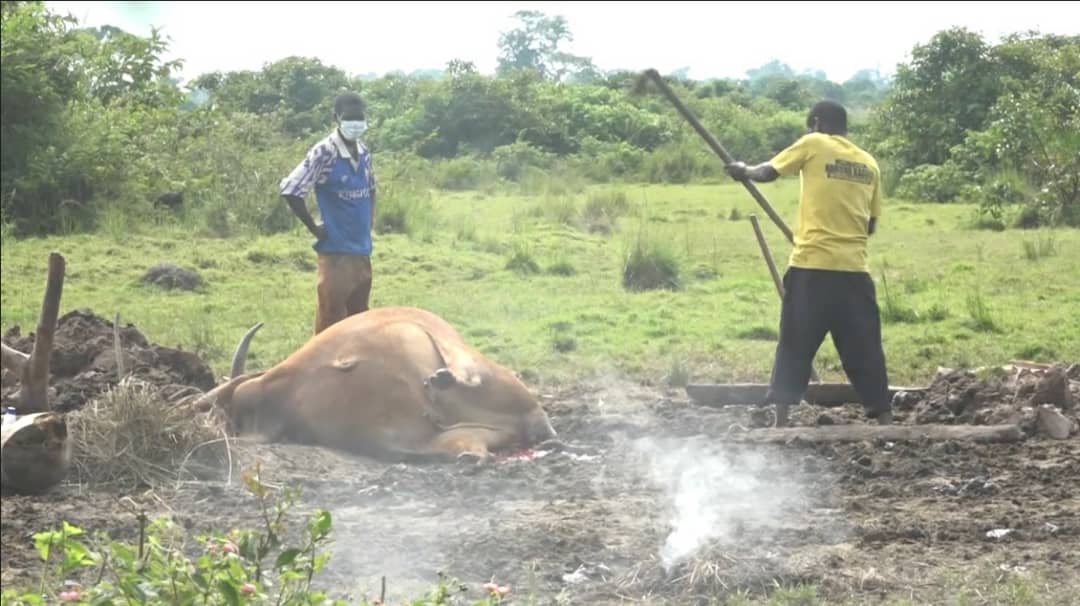
The Ministry of Agriculture, Animal Industry and Fisheries (MAAIF) has activated emergency response measures following a suspected anthrax outbreak at a farm in Birongo I, Rwambu Parish, Kijongo Sub-county, Ibanda District.
So far, seven cattle have died, and four people who came into contact with one of the dead animals have developed skin lesions consistent with cutaneous anthrax. The affected individuals are receiving medical care, and samples have been submitted for laboratory confirmation.
Anthrax is a highly dangerous zoonotic disease caused by the bacterium Bacillus anthracis, which forms spores capable of surviving in the environment for more than a century. The disease can be transmitted through ingestion, inhalation, or skin contact with infected animals or contaminated materials, but it does not spread from person to person.
MAAIF has conducted joint veterinary and public health investigations and carried out emergency vaccination at the affected farm. Ring vaccination is ongoing in surrounding areas to prevent further spread, while quarantine restrictions have been imposed in Kijongo Sub-county. Carcasses are being safely disposed of under supervision, environmental decontamination is underway, and community sensitisation campaigns on identifying, preventing, and reporting anthrax cases are in progress.
“The Ministry has conducted joint veterinary and public health investigations, with samples submitted for laboratory confirmation,” MAAIF said in a statement.
Farmers and the public have been urged to remain alert and cooperate with containment efforts. Members of the public are advised to avoid handling or consuming meat from dead or visibly sick animals, report sudden animal deaths to District Veterinary Officers, and seek immediate medical attention if skin sores or fever develop after contact with animals.
MAAIF also advised buying meat only from certified slaughter facilities, avoiding careless opening of carcasses, and refraining from spreading unverified information. Maj. Gen. David Kasura-Kyomukama, Permanent Secretary of MAAIF, called on communities to work closely with veterinary and public health teams to stop the spread of the disease.
Uganda has experienced recurring anthrax outbreaks over the past decade, particularly in districts along the cattle corridor. Major outbreaks were recorded in Isingiro in 2017, Kiruhura and Kween in 2018, and more recently in Ibanda, Kyotera, Amudat, and Sembabule between 2023 and 2024, causing livestock deaths and several human infections.
Anthrax manifests in three forms: cutaneous, from skin contact during slaughter or handling of infected animals; gastrointestinal, from consuming contaminated meat; and respiratory, from inhaling spores, especially in industries dealing with leather or wool.
MAAIF emphasised that annual livestock vaccination, safe carcass disposal, and continuous public awareness are critical for preventing and controlling future outbreaks.
